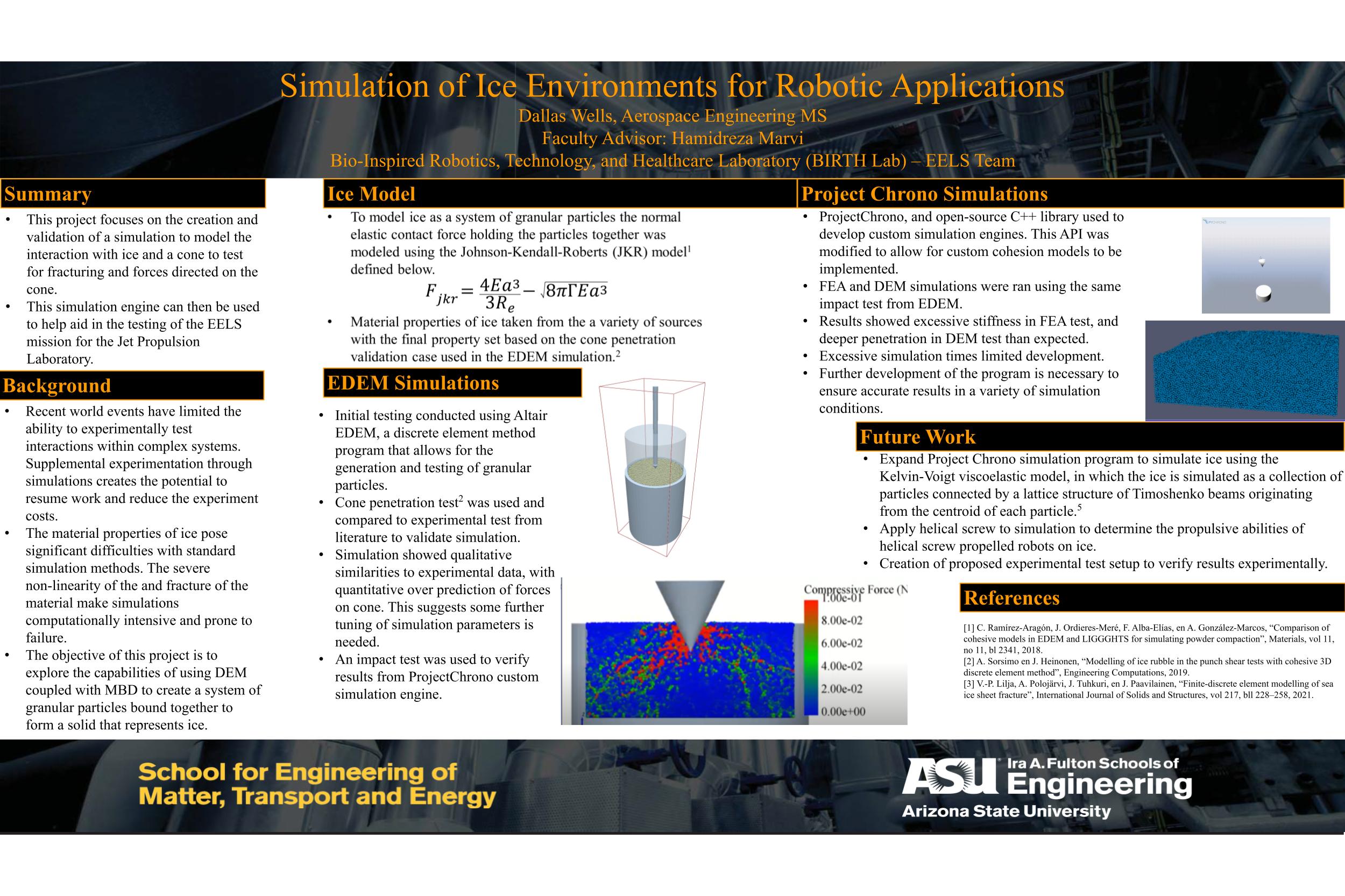
Student: Dallas Wells
Committee: Dr. Hamidreza Marvi
Abstract:
The use of simulations allows for reduction in cost and the ability to remotely gain experimental test data. Ice as a material is difficult to simulate due to strong non-linear properties that can vary with temperature and fracturing can cause singularities resulting in simulation failure. In this project, the simulation of ice is attempted through the use of MBD and DEM to simulate the ice as a collection of granular particles bound together through a cohesive contact force using the JKR model. The software EDEM and ProjectChrono were used to verify the accuracy of the simulation model. In EDEM a cone penetration test was conducted to compare to experimental data from literature. The results showed qualitative correlation to the data, yet quantitatively overpredicted the force values suggesting further tuning is necessary. An impact test of dropping a cone into the bed was conducted to verify ProjectChrono results. The impact test was conducted in ProjectChrono twice, first with standard FEA and then with a granular test bed. The FEA resulted in excessive stiffness in the ice model and the granular test resulted in excessive penetration into ice bed. While these methods show promise in their ability to simulate ice, further refinement of the programs is necessary in order to obtain sufficiently accurate experimental results from the simulations.
Zoom Room: https://asu.zoom.us/j/4698077336
Presentation Time: 12:00-1:00 PM (Arizona Time)