Student: Muhammad Saqlain Haider
Committee: Dr. Patrick Phelan
Abstract:
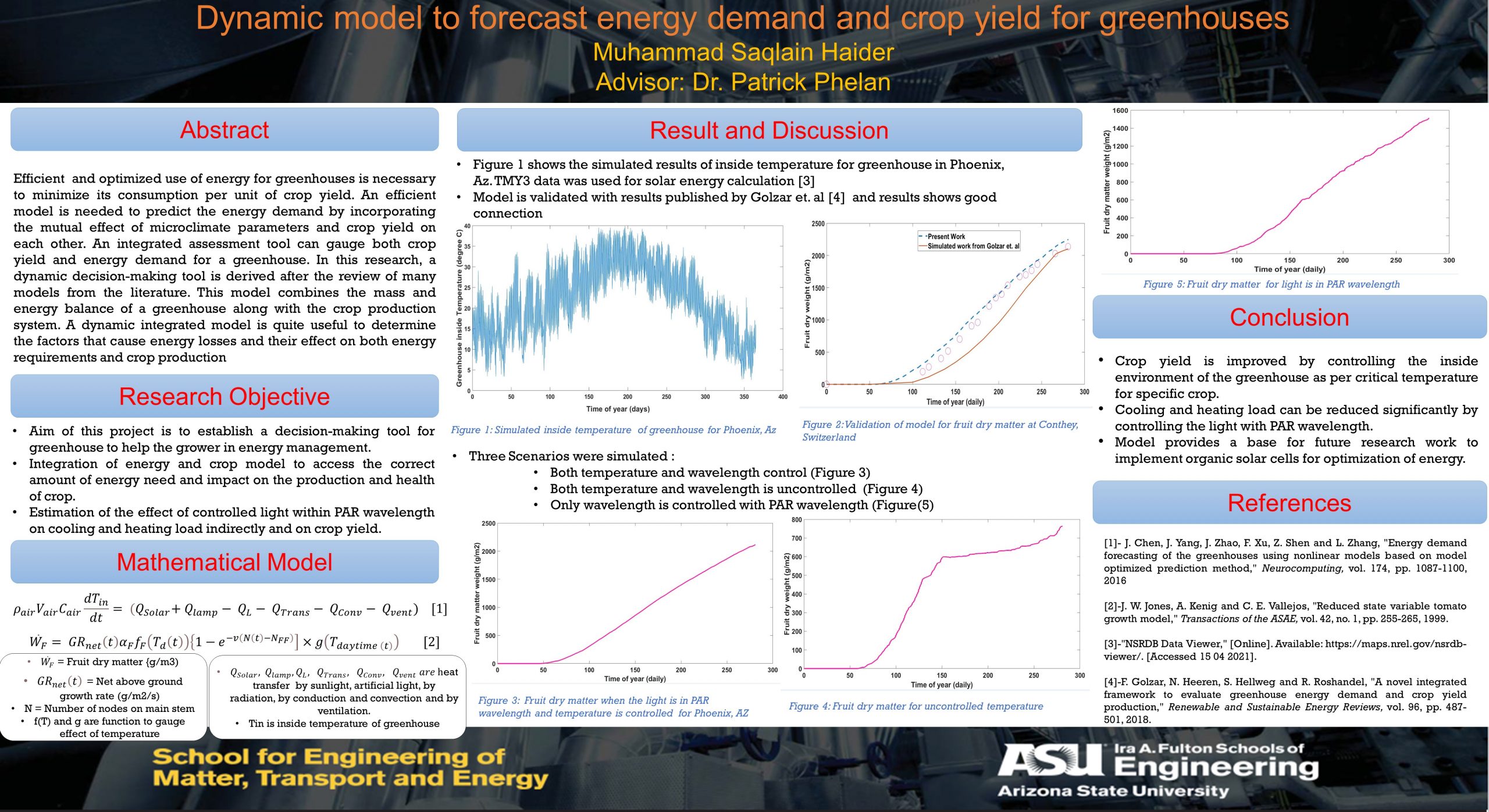
Efficient use of energy and its conservation is essential for greenhouse because they need a lot of energy even more than conventional agricultural systems. Optimization of energy is necessary to minimize its consumption per unit of crop yield. An efficient model is needed to predict the energy demand by incorporating the mutual effect of microclimate parameters and crop yield on each other. An integrated assessment tool can gauge both crop yield and energy demand for a greenhouse. In this research, a dynamic decision-making tool is derived after the review of many models from the literature. This model combines the mass and energy balance of a greenhouse along with the crop production system. Validation of this model is performed for a 280-days growing period for tomatoes in Conthey, Switzerland and Phoenix, Arizona. A dynamic integrated model is quite useful to determine the factors that cause energy losses and their effect on both energy requirements and crop production. The impact of solar light within the visible portion of the spectrum (called photosynthetic active radiation) is also analyzed and results clearly show the potential to use renewable energy technologies (especially transparent or semitransparent solar panels) for greenhouses. Implementation of organic solar cells can also be helpful to turn a greenhouse into a net zero energy building. Analysis is performed for the inside temperature of the greenhouse by considering the different heat transfer mechanisms (conduction, convection, radiation, and transpiration) and for the yield of the tomato crop. Results clearly show that the dynamic integrated model can be helpful in estimation of the exact amount of energy demand and is a decision-making tool for growers and agricultural markets.
Zoom Room: https://asu.zoom.us/j/9313372012
Presentation Time: 12:00-1:00 pm Arizona Time